
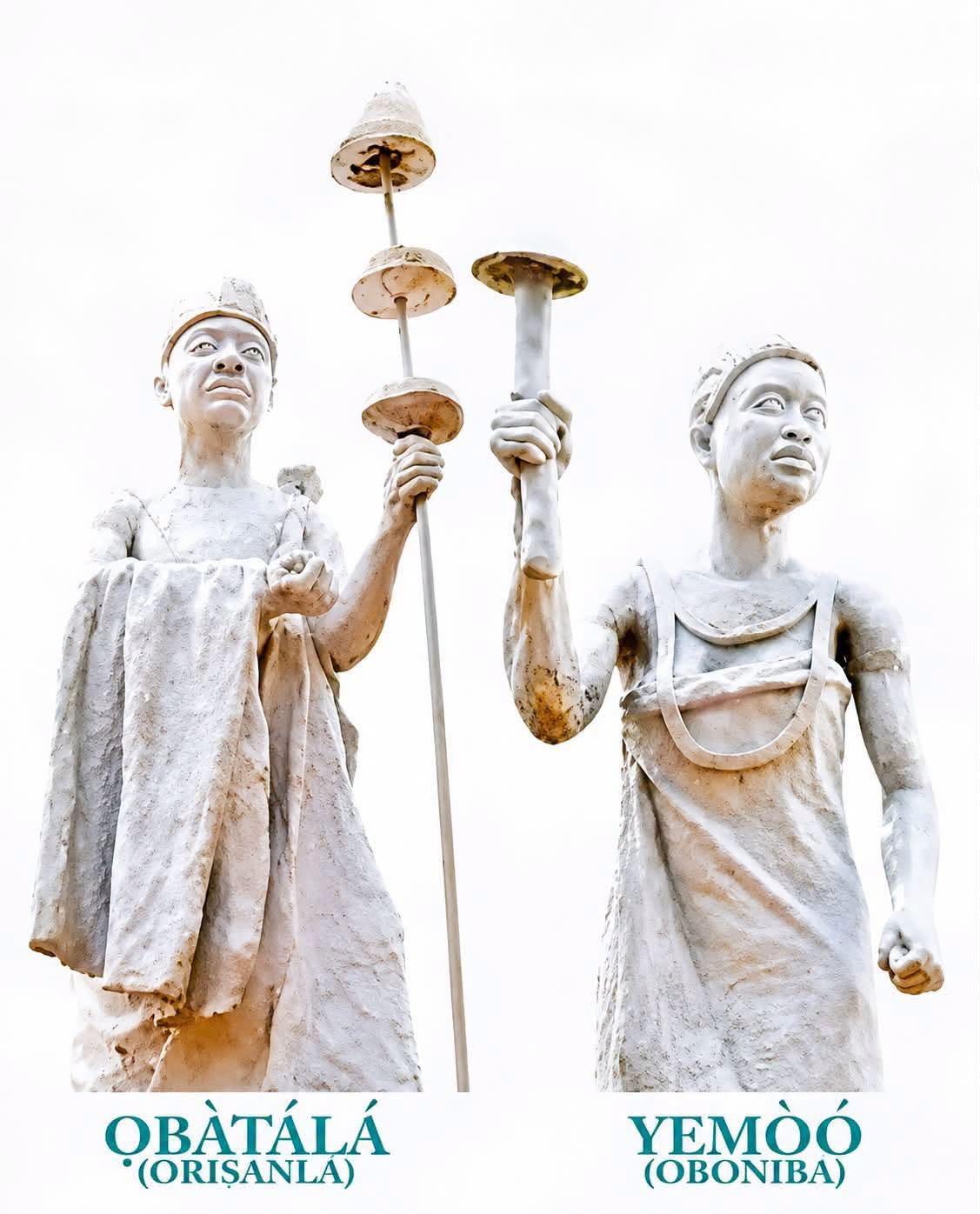
Òrìṣà-Nlá Obàtálá is revered as the divine sculptor of humanity and the Òrìṣà of wisdom, purity, patience, justice and peace.
Òrìṣà-Nlá Obàtálá (Ọ̀rìṣànlá, “the Great Òrìṣà”) occupies an ancient and distinguished position within the religious, cultural and historical traditions of the Yoruba people, and is intimately associated with Ilé-Ifẹ̀, the ancient spiritual centre of Yoruba civilization.
Within Yoruba cosmology, Obàtálá belongs to the sacred narrative of creation and the formation of humanity. Within the oral and royal traditions of Ilé-Ifẹ̀, Oba Obàtálá—Olufe—is remembered as a foundational ruler and, in traditions identifying him as founder of the city, its first king. [1][2]
These interconnected traditions—cosmological, historical, royal and philosophical—have made Òrìṣà-Nlá an enduring symbol of human dignity, sacred authority and responsible leadership.
Creation
The Creation of the Earth and of Humanity
According to Yoruba oral tradition, Olodumare, the Supreme Being, entrusted Òrìṣà-Nlá with the ordering of the earth. The tradition recounts his descent upon a chain of gold, bearing a snail shell filled with sand, a hen and a palm nut. The sand was cast upon the primordial waters and scattered by the hen, forming the hills and valleys of Ife, remembered as the cradle of Yoruba civilization, while the palm nut gave rise to the first forest. [1][3]
Obàtálá then fashioned the human body from clay, and Olodumare bestowed upon it the vital breath of life. It is from this sacred responsibility that Òrìṣà-Nlá derives his enduring identity as the Sculptor and Father of Humanity, and as the owner of the head in which the human soul resides.
The creation tradition conveys a broader principle:
Human life possesses inherent dignity.
Human worth cannot be determined by ethnicity, nationality, physical appearance, wealth, social position or political power. Humanity shares a sacred origin and therefore carries a corresponding responsibility toward one another.
Discipline
The Palm Wine Tradition and the Sanctity of Every Form
A tradition long preserved in Ilé-Ifẹ̀ recounts that, in the course of the creative work, Òrìṣà-Nlá drank palm wine and, his hand no longer steady, shaped bodies bearing physical differences. On regaining his clarity he renounced palm wine for ever and took those he had formed into his particular protection.
From this tradition arises the enduring sanctity of persons living with disability, albinism and physical difference within the household of Obàtálá, and the discipline of sobriety, restraint and purity required of his priesthood and of those who bear his authority.
The White Cloth
The King of White Cloth
White is the sacred colour of Òrìṣà-Nlá, and his association with white cloth is recorded in the earliest published accounts of Yoruba religion and remains central to his tradition today. [3]
Purity • Clarity • Wisdom • Patience • Justice • Integrity • Peace
The white cloth carries meaning beyond ceremonial appearance. It declares the moral expectation of the House: that clarity precede judgment, that patience precede reaction, that justice precede self-interest, and that peace be pursued wherever reconciliation remains possible.
Consciousness & Destiny
Òrìṣà-Nlá and Ori
In Yoruba philosophical thought, Ori signifies the head, yet its meaning extends far beyond anatomy. Ori encompasses consciousness, individual identity, character, judgment and destiny.
As the divine sculptor of humanity, Òrìṣà-Nlá's relationship with the human head binds the act of creation to the responsibilities of consciousness. From this follows a principle of leadership:
Before one can responsibly govern others, one must possess the discipline to govern oneself.
Wisdom and self-restraint are therefore essential characteristics of legitimate authority.
Dignity
Human Dignity and Inclusion
The traditions of Obàtálá preserve a distinctive relationship with persons possessing physical differences and disabilities, who have historically held a place of honour within communities dedicated to him.
Physical difference does not diminish human worth.
Understood within a contemporary heritage framework, this dimension of the Obàtálá tradition speaks directly to inclusion, compassion, the equality of human dignity and the protection of the vulnerable.
Continuity
A Living Heritage
The heritage of Òrìṣà-Nlá cannot be understood through written texts alone. For generations it has been transmitted through:
- Oral tradition
- Festivals and ceremonies
- Sacred music and prayer
- Royal and religious institutions
- Traditional arts
- Sacred spaces
- Family and priestly lineages
- Community memory
- Ritual practice
It is a living heritage.
The continuing performance of festivals, the preservation of sacred knowledge and the transmission of oral history bind contemporary communities to the generations that preceded them.
Sources & Further Reading
[1]McKenzie, J. A. — Report on the Native Organisation of Ife District, Oyo Province
A historical source concerning the indigenous political and social organization of Ilé-Ifẹ̀ and the traditions surrounding its early rulers, including Obàtálá's position as Olufe, founder and ruler of Ilé-Ifẹ̀.
[2]Frobenius, Leo — The Voice of Africa (1913)
An early twentieth-century documentation of Yoruba culture and Ilé-Ifẹ̀, recording traditions, religious institutions and historical narratives encountered in Yorubaland.
Internet Archive / digitized historical editions →[3]Ellis, A. B. — The Yoruba-Speaking Peoples of the Slave Coast of West Africa (1894)
An early published ethnographic account of Yoruba religious tradition, documenting Obàtálá's position within Yoruba religion and his association with white cloth and the creation traditions.
Internet Sacred Text Archive →[4]Encyclopaedia Britannica — “Ilé-Ifẹ̀”
Broader historical and cultural context concerning Ilé-Ifẹ̀ and its importance within Yoruba civilization.
Read online →Note on Historical and Oral Traditions
The history of ancient Ilé-Ifẹ̀ has been preserved through a combination of oral traditions, ritual practices, royal genealogies, archaeological research and written historical accounts.
Different communities and lineages may preserve different accounts of the earliest rulers and events associated with the formation of Ilé-Ifẹ̀.
Accordingly, this publication identifies statements concerning Obàtálá as Founder and First King of Ilé-Ifẹ̀ as belonging to the indigenous oral and historical traditions in which Obàtálá, bearing the appellation Olufe, occupies that foundational position.
This approach recognizes oral tradition as an authoritative form of cultural knowledge while distinguishing traditional historical memory from conclusions established exclusively through modern archaeological chronology.